Sunday, November 14, 2010

Problem of the Week #2

As always, we welcome you to send in solutions, or even any ideas you have about how to solve the problems to the.physics.virtuosi@gmail.com with “problem of the week” in the subject line. We will keep track of the top Virtuosi problem solvers.

Why did the ant cross the rubber band?

A rubber band is held fixed at one end. The other end is pulled at a velocity v. At time t = 0, the rubber band has a length of L, and an ant starts crawling from one end to the other at velocity u.

Does the ant reach the other side? If so, how long does it take to get there? Assume that the rubber band is able to be stretched indefinitely without breaking.

Pet Projects

You're doing it wrong!
Here at the Virtuosi, we have a very specific way of asking a very specific type of question that sounds anything but specific.  These are the "How come [blank]?" questions [1].  These are very simple questions that just about every four year old asks, but likely never get sufficiently answered.  To  get a feel for what I mean by these questions I provide the following translations of problems we have either considered or will consider:

Q:  How come trees?
Translation:  How tall can trees be?

Q:  How come plants?
Translation:  Why are plants green?

These are my very favorite types of questions because they are completely understandable by everyone and promise to have very interesting physics working behind the scenes.  So I've been thrilled to see two such questions considered by scientists lately that have also had a good run  in popular media.  They are:

Q:  How come cats?
Translation:  How do cats drink?

and

Q:  How come dogs?
Translation:  How do dogs shake?

Monday, November 8, 2010

Your Week in Seminars Dark Edition

Good afternoon everyone, and welcome to another week of seminars here in the physics department. Our theme of the week is dark matter - where does it come from, how do we see it, and why is there so much of it. Along with that we have a little more AdS/CFT, seemingly continuing last week's subjects theme. All in all, it looks like seminars on similar subjects tend to condense here in the department.


Friday, November 5, 2010

Problem of the Week #1

I thought we could spice things up a bit with a more interactive post on The Virtuosi. Starting this week, a new problem of the week will be posted each week. Solutions will be posted the following week. These problems will be a collection of physics and math problems and riddles, and although hopefully challenging enough to be fun and interesting, they should mostly be solvable using concepts from introductory undergraduate physics and math classes.

We welcome you to ponder these problems, and send in solutions, or even any ideas you have about how to solve the problems to the.physics.virtuosi@gmail.com with “problem of the week” in the subject line. We will keep track of the top Virtuosi problem solvers.

Here it goes…


Monday, November 1, 2010

Your Week in Seminars: Conformal Edition

Another week has gone by here in Cornell. The last leaves are turning red, a hint of snow passed us on the weekend, and the undergrads have hit the streets and parties in minimal clothing, then did the same again next day wearing a set of cat ears. And in the physics department, we had the usual three talks.


Monday, October 25, 2010

Your Week in Seminars Fermionic Edition

Good evening, and welcome to the second edition of YWiS. Last week I took in the full range of seminars, from colloquium to Friday lunch. I don't know if I can say I took in the full content of these talks as well, but let's see what I learned


Thursday, October 21, 2010

Paradigm Shifts 3: With a Vengence

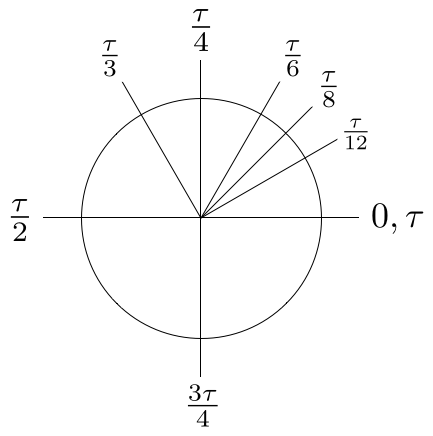
The last shift I wanted to present is best explained at http://tauday.com/ . There you will find a manifesto (yes, a manifesto) about why we should change from using \[ \pi = \text{180 degrees} \] as the circle constant to \[ \tau = 2 \pi = \text{360 degrees} \] It's quite a convincing argument, and it's a shift that can easily be made. Check the website for more.

TAU VS PI


Monday, October 18, 2010

Your Week in Seminars Intro Edition

We've done a lot of talking over the past few months here on the Virtuosi, but one important subject has not come up so far. An issue that is central to the day to day life of the average grad student. The subject of free food.

The average graduate student in an American university shops for food 0.7 times per semester, paying a total of $13.22. He eats an average of three vegetables and one fruit, all at home during Thanksgiving. He turns his oven on once per year while trying to ascertain if the power is out or the light bulb in the kitchen needs to be replaced. The rest of his nutrition is made up entirely of free donuts, bagels and pizza.

The place to get all this free food, naturally, is various department talks and seminars. And while we're there, we may as well try to learn some physics.


Saturday, October 16, 2010

Four Fantastic Books (3 of which are free)

Well, we just had our fall break, which means I get a bit of a break, coincidently enough. Somehow I've managed to read three books in the last two days, and each of them were excellent enough that I need to tell people about them.

Street Fighting Mathematics - Sanjoy Mahajan

The art of educated guessing and opportunistic problem solving

Link to MIT Press Site

You know that feeling you get when it's the second half of January and you put on new clothes that have just come out of the dryer? This book is like a cross between that and a kick in the face.

The warm fuzzy-clothes-out-of-the-dryer feeling will come from the realization that you can wield unsurmountable power. The kick in the face will come when you realize you're not doing it yet.

Sunday, October 10, 2010

Caught In The Rain II

I was rather proud of my last post about being caught in the rain.  In that post, I concluded that you were better off running in the rain, but that the net effect wasn't incredibly great.  However, when I told people about it, the question I inevitably got asked was:  What if the rain isn't vertical?  That's what I'd like to look at today, and it turns out to be a much more challenging question.